
Understanding Concrete Absorption: A Deeper Look at Durability
Overview
The absorption test, sometimes referred to as a sorptivity test, provides additional insight into how well concrete resists water ingress, a critical factor in infrastructure longevity, especially in harsh environments where chloride and sulphate exposure is a concern.
This article breaks down how absorption testing works, highlights its limitations, and explains how Kryton’s Krystol Internal Membrane (KIM) admixture can help overcome them.
What Is Concrete Absorption Testing?
Absorption testing measures the amount of water concrete absorbs through capillary suction, a mechanism that allows water to migrate into pores and microcracks. The test helps engineers gauge a mix’s ability to resist moisture-related deterioration over time.
Generally, the lower the absorption, the better the performance in applications involving groundwater, freeze-thaw cycles, or chemical attack.
Relevant standards include:
- BS 1881-122:2011 – Method for Determination of Water Absorption
- ASTM C1585 – Rate of Water Absorption by Hydraulic-Cement Concrete
Testing Procedure
The typical absorption test involves:
- Curing: Concrete cylinders are cast and moist-cured for a set period, usually 28 days.
- Sectioning: A 50 mm (2-inch) slice is cut from the cylinder and conditioned in a climate-controlled chamber.
- Sealing: The sample’s sides and top are sealed with epoxy to direct absorption through only one surface.
- Immersion: The slice is placed in water, and weight is recorded at intervals to determine how much water is absorbed.
This gives a quantitative profile of how quickly and to what extent concrete draws in moisture.
Challenges and Shortcomings
Although widely used, absorption testing has a few critical limitations:
- Doesn’t Consider Internal Reactions: Some admixtures like KIM continue reacting with moisture over time, which isn’t accounted for in early-stage testing.
- Simplistic Weight Assumptions: The test assumes all weight gain comes from water, which may not always be accurate.
- Short-Term Focus: Many tests are conducted after 28 days, missing long-term material performance.
This can lead to underestimating the durability of high-performance concretes designed for self-healing or internal waterproofing.
How Kryton’s KIM Enhances Watertightness
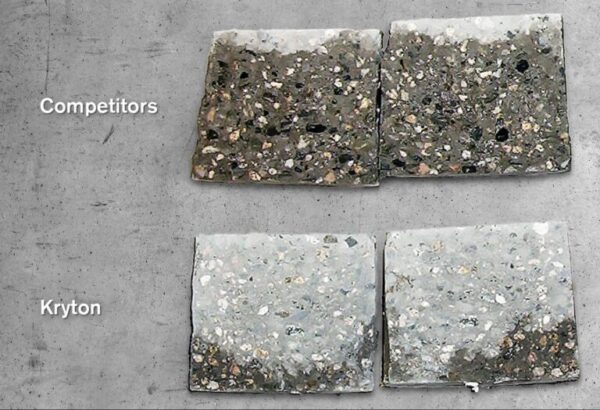
Krystol Internal Membrane (KIM) is a crystalline waterproofing admixture that chemically reacts within the concrete matrix to form long-lasting, insoluble crystals. These crystals fill voids and microcracks, significantly reducing permeability.
However, the performance of KIM improves over time. Initial testing at 28 days may not fully reflect the admixture’s capabilities. To get a more accurate assessment, absorption testing should be extended to 56 or even 90 days.
This allows enough time for the internal crystal growth to complete, ensuring a truer picture of the mix’s resistance to water ingress.
Better Durability Through Broader Testing
Absorption testing is a valuable tool, but it’s just one piece of the puzzle. For a more holistic view of concrete’s long-term performance, it should be paired with:
- Permeability Testing
- Rapid Chloride Permeability Testing (RCPT)
- Shrinkage or Microcrack Propagation Studies
When used together, these tests provide a multi-faceted assessment of how concrete will perform in real-world conditions, especially in critical infrastructure exposed to aggressive environments.
Final Thoughts
Concrete durability isn’t just about compressive strength, it’s about how the material interacts with water and chemicals over time. Absorption testing, especially when timed correctly and paired with innovative admixtures like KIM, helps engineers make smarter, more resilient design decisions.
To learn more about how Kryton technologies improve concrete performance from the inside out, explore our full suite of testing resources and waterproofing solutions.